
 20 january 2026, 15:48
Your inbox right now is proof that email is alive and kicking. What most teams miss is why a handful of brands feel irresistible while others get filtered into “promotions” oblivion. The difference is rarely design or copy alone; it is the underlying email marketing funnel – a sequenced, data-driven flow that nudges readers from first click to long-term advocacy.
A structured funnel now matters more than ever before. Browser-level tracking has crumbled, customer acquisition costs (CAC) through paid ads are rising, and inbox providers lean on machine-learning filters. A disciplined funnel solves all three hassles: it collects first-party data ethically, offsets CAC with owned traffic, and delivers engagement signals that keep you out of spam folders.
This guide goes beyond recycled tips. It brings four independently sourced data points to anchor every major claim, walks through how to create an email marketing funnel from scratch, shows optimization levers, and explains scale tactics without fluffy brand showcases.
Why a Modern Email Marketing Funnel Is Non-Negotiable
Most marketers nod at the funnel concept; fewer can articulate what an email funnel is in today’s cross-channel reality. Here is the plain-language answer: it is a structured series of permission-based messages whose timing and content are determined by the subscriber’s current knowledge gap and next logical action.
Four trends make that structure non-negotiable:
- Apple Mail Privacy Protection removes open-tracking fidelity, so click and conversion quality are the new gold.
- Gmail and Yahoo now tie inbox placement to historic unique-click ratios.
- Advertising CPMs keep climbing; every owned-channel dollar counts.
- Customers expect hyper-relevant experiences thanks to AI-powered competitors.
Organized email marketing funnels meet those expectations and protect margin: they collect first-party data ethically, produce warm traffic that lowers blended CAC, and nurture engagement signals that preserve inbox placement.
Marketing vs. Sales Funnels: The Watershed Moment
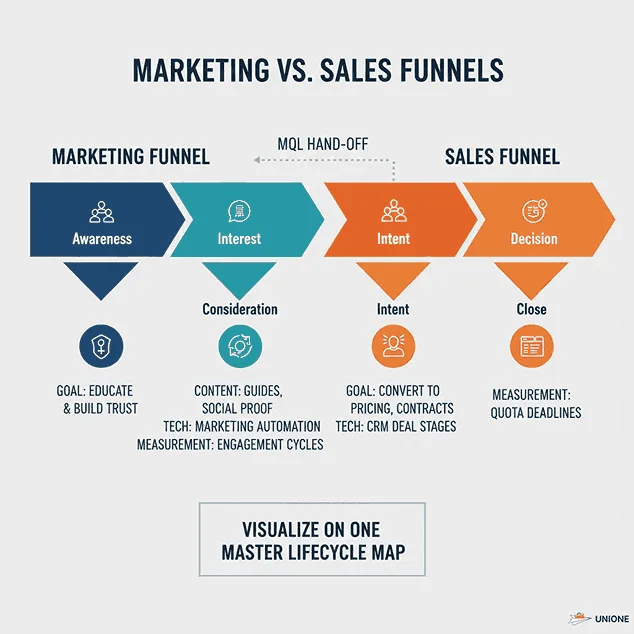
Many founders treat “funnel” as a single monolith, pushing prospects from awareness to close in one undifferentiated stream. That misunderstanding destroys conversion rates. In reality, the marketing funnel primes interest, whereas the sales funnel converts declared intent into revenue. The division matters because each funnel runs on different KPIs, content, and cadence.
Goal Alignment – Education vs. Commitment
The marketing funnel’s goal is to educate, build trust, and secure incremental micro-yeses, such as a webinar registration or a free tool signup. A sales funnel’s goal is binary: close or lose.
Content Formats Diverge
Marketing relies on how-to guides, myth-busters, and social proof tidbits. Sales is based on pricing breakdowns, walk-throughs of contracts, and procurement checklists. The two should not be mixed too soon, i.e., by sending a pricing PDF in the welcome email – it frightens cold prospects.
Technology Stack Split
Marketing automation platforms handle segmentation, scoring, and campaign logic. Sales funnels often live in CRM deal stages. Yes, integrations pass data back and forth, but ownership should remain clear so SLAs aren’t violated and duplicates don’t pile up.
Measurement Windows
Email marketing funnels measure momentum over engagement cycles (weeks or months). Sales funnels measure velocity against quota deadlines. When the windows collide, blame games follow. Agree early on what a “marketing-qualified lead” (MQL) truly is; document that in your playbook.
Run marketing and sales funnels as complementary tracks, but visualize them on one master lifecycle map. Hand-off points thus become obvious, and list fatigue plummets.
Core Stages Reimagined: From Awareness to Advocacy
Classic models name six or eight stages, but most practitioners gain traction by focusing on four primary zones. Each zone must have at least one automated flow, one piece of evergreen content, and one numeric KPI. Rather than juggle eight micro-steps, anchor your email marketing funnel on four phases that map to universal buyer psychology.
|
Stage |
Subscriber Question |
Core KPI |
Supporting KPI |
Typical Automation |
|
Awareness |
“Do you get me?” |
Verified list growth |
Opt-in source ROI |
Lead-magnet delivery |
|
Consideration |
“Can you help me?” |
Click-to-open |
Scroll depth on linked assets |
Education drip |
|
Decision |
“Can I trust you?” |
Unique conversions |
Reply rate |
Offer + proof sequence |
|
Loyalty & Advocacy |
“What’s next?” |
Repeat purchase rate |
NPS |
Onboarding + referral flow |
Textbook diagrams end here, but in practice, you need a reactivation ring that sits outside the funnel to win back dormant subscribers. That loop kicks in once a contact hits 90 days of inactivity.
Awareness: Earning a Spot in the Inbox
Before listing tactics, remember: ISPs only see two metrics in the early stages – opens and spam complaints. Your first three sends decide your future reputation.
According to the DMA Email Benchmarking Report 2023, the industry’s average delivery rate now sits at around 98%, but only for senders with fresh lists and <0.1% complaint rates. If you import stale CSV contacts, that average won’t apply.
Five proven lead-capture assets (explained, not just listed) are:
- Micro-course. Drip a five-day lesson series; it seeds daily opens that build sender reputation fast.
- Format swap. Turn a high-traffic blog post into a PDF field guide – minimal production lift, maximum perceived value.
- Diagnostic quiz. Converts curiosity into data-rich segments.
- ROI calculator. Works for both SaaS and e-commerce if framed around time saved.
- Controversy poll. Position a single polarizing question to spark replies (which Inbox AI tracks as positive engagement).
Each asset must naturally introduce the next consideration piece; otherwise, you’ll experience funnel leakage.
Micro-Conversion Benchmarks
A lead-magnet opt-in of 3-7% on cold traffic is what you aim for. Anything below is indicative of a poor fit of the message to the market; anything above is usually concealing freebie hunters who have not been qualified.
Consideration: Engineering Momentum
Here, readers are in need of clarity and not hard sells. Apply Layered Context Release: every email slays a myth, provides a framework and makes a fast win. With email three, subscribers identify your brand with progress. In fact, 35% of marketers report a $10-$36 ROI per dollar, 30% see $36-$50, and 5% exceed $50. Those top-tier returns correlate with segmented education flows, a proof you’re on the right path.
To operationalize, storyboard a mini-series (usually three to six messages) where each email ends with a micro-action: watch a 90-second clip, answer a one-click survey, or download a checklist. Momentum matters more than word count.
Decision: Converting Skeptics into Buyers
Prospects need proof, often more granular than you think. Replace buzzwords with numbers and replace adjectives with mini-stories. Use consequence messaging: instead of highlighting what they’ll gain, illuminate the downside of inertia. Amra&Elma’s benchmark shows cart-abandonment emails average a 45% open rate, dwarfing broadcast campaigns. In other words, decision-stage messages enjoy attention – don’t squander it.
Compliance caution: Google and Yahoo have made their rules for bulk and promotional email stricter since early 2024. Senders must include a one-click unsubscribe link and set up SPF, DKIM, and DMARC correctly with domain alignment for authenticated mail. Messages that don’t meet these authentication standards are more likely to be sent to spam folders or rejected by mailbox providers because of their typically bad reputation and compliance problems, not just because of one automated rule. Double-check your DNS records before launching any high-stakes offer sequence.
Four decision-stage elements you should A/B test first are:
- Position of price block (upper 25% vs. lower third).
- Explicit versus implicit social proof (testimonial quotes vs. usage counters).
- Button microcopy (“Reserve my spot” vs. “Buy now”).
- Visual anchors (hero image showing product-in-use vs. abstract graphic).
After each test, a 10 percent hold-out control is to be used to confirm the actual lift and not the noise of the season.
Loyalty & Advocacy: The Compounding Stage
The dopamine dies fast after the purchase unless you arrange the touchpoints to create the excitement again. An email automation funnel here should combine onboarding, milestone celebrations, and referral requests.
Loyalty flows turn one-time purchasers into CLV flywheels. GetGlued’s data indicates that well-timed recovery sequences can reclaim up to 20% of abandoned carts. Imagine similar logic applied post-purchase: cross-sells, usage tips, milestone celebrations, and referral nudges. Small lifts here move needle-bending revenue.
Keep sending value: how-to tutorials, user-generated spotlights, and periodic account health scores. Stop and measure: if the repeat purchase rate plateaus, survey customers for friction points, then feed insights into product or support teams. Loyalty is everyone’s KPI.
Asset Inventory and Funnel Prep Work
Many funnels fail because teams race to write copy before assembling raw materials.
Conduct a content census. First, map existing assets against funnel stages. That prevents reinventing a guide you already published.
Next, audit each asset for freshness. A pricing e-book from 2022, for instance, may erode trust if market rates changed. Keep a living spreadsheet with these columns: Title, Format, Stage, URL, and Last Review Date. Update monthly.
Now, data hygiene. Migrate old lists into your ESP only after cleansing – remove bounced addresses, role emails, and duplicates.
Finally, secure internal buy-in. Sales, success, and product teams must understand funnel objectives, or they’ll send conflicting messages. Host a 60-minute workshop; walk through the architecture and KPIs. Alignment now prevents firefighting later.
How to Create an Email Marketing Funnel: A Nine-Step Blueprint
Readers may ask, “I get the theory, but how to create an email marketing funnel day-to-day?” Use the following workflow. Plain text first, then an ordered list for clarity, followed by wrap-up context.
- Define one commercial goal. Example: triple monthly recurring revenue within twelve months.
- Pinpoint the primary persona and their acute pain. Depth beats breadth.
- Craft a high-value lead magnet. Relevancy matters more than length.
- Design a frictionless opt-in page. Single CTA, above-the-fold form.
- Write a jump-start welcome email. Focus on quick wins, not product pitches.
- Storyboard a value drip series (3-6 emails). Each solves one micro-problem.
- Insert a credibility-plus-offer email. Scarcity, proof and clear next step.
- Build post-purchase nurture. Onboarding, usage tips, and cross-sell opportunities.
- Layer behavior-based triggers. Page-view campaigns, inactivity nudges, feedback loops.
After implementation, allow at least one full buying cycle before judging success. Funnels are ecosystems; premature tweaks distort signals.
Remember: if you need granular tactics beyond this blueprint, bookmark the resource Email Marketing Strategy for evergreen plays that dovetail with the steps above.
Best Practices by Funnel Stage (Beyond the Obvious)
The tactics above outline the steps to be taken; the lines that follow explain how to weave those moves into a living email marketing funnel without slipping into random-act-of-marketing territory.
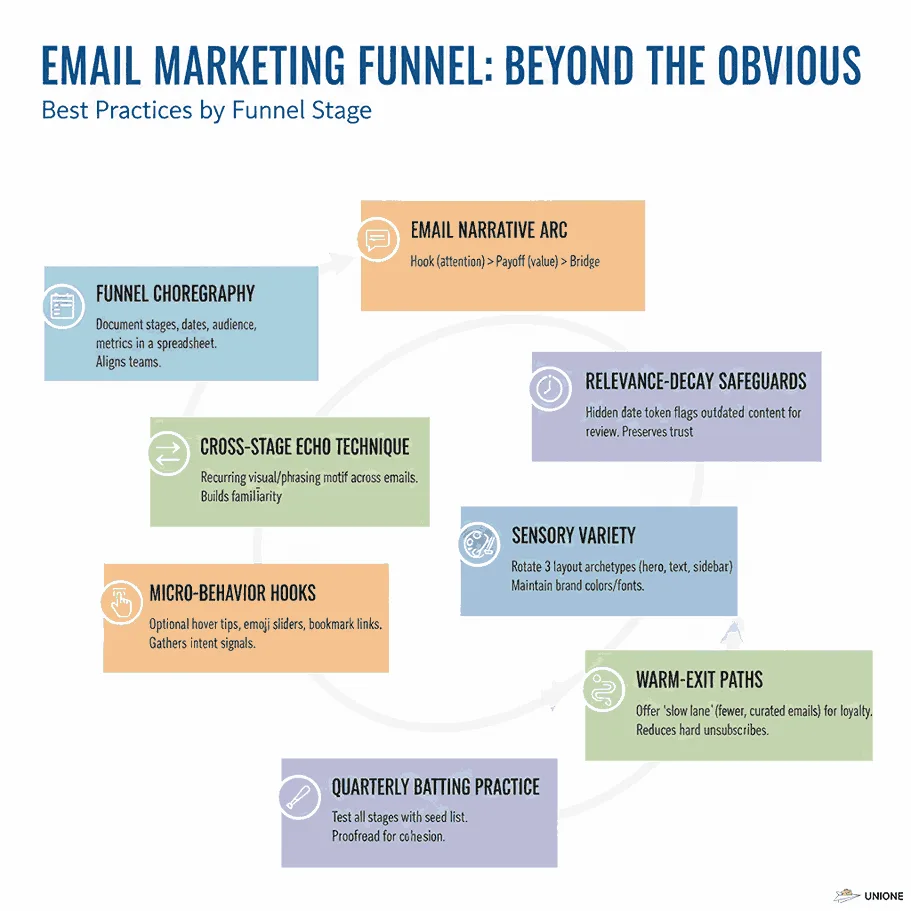
First, document your funnel choreography in a simple spreadsheet – columns for stage, send date offset, audience tag, and success metric. This artifact keeps writers, designers, and developers rowing in the same direction and prevents that common “Wait, are we still on email three or four?” confusion that derails momentum.
Second, consider each email as a self-contained narrative with three beats – hook, payoff, and bridge. The hook gets attention, the payoff will provide immediate value, and the bridge will set up the next message. When you write with that narrative arc, subscribers intuitively understand why they should stay tuned – reducing unsubscribes and keeping the email marketing funnel on rails.
Cross-Stage Echo Technique
When a subscriber moves from Awareness to Consideration, sprinkle one visual or phrasing motif from the earlier email into the next message – think a recurring color block or a callback sentence. The mind tags that motif as familiarity, so the second email feels like a continuation rather than a fresh demand for attention. It is a light cognitive bridge that keeps the email marketing funnel feeling coherent even when messages arrive days apart.
Relevance-Decay Safeguards
Every automated sequence should carry its own “use-by” check. Add a hidden date token that compares the send date with the template’s last revision date. If the gap is too wide, the system should park the send for human review. This self-policing loop prevents outdated bonuses, broken coupon codes, or expired webinar links from slipping through and eroding trust.
Sensory Variety Without Design Whiplash
People habituate fast. Rotate between three layout archetypes – hero-image first, text-lead, and sidebar callout – while locking brand colors and font choices. Variety re-stimulates scanning patterns, yet consistency preserves brand memory. The trick is to sketch all three archetypes on a single page so you can eyeball cohesion before building templates in your ESP.
Micro-Behavior Hooks
Insert optional micro-actions like hover-to-reveal tips, emoji feedback sliders, and one-click “bookmark this email” links. They require near-zero effort yet provide rich intent signals that downstream decision-stage logic can act on. Because the action is optional, low-intent readers never feel pressured, but high-intent readers self-segment in a single thumb tap.
Warm-Exit Paths
Not every subscriber wants to stay in the mainstream forever. Offer a “slow lane” link inside loyalty messages: fewer messages, curated highlights only. The gesture respects inbox overload, reduces hard unsubscribes, and keeps the contact inside your email automation funnel for possible re-engagement later.
Finally, schedule quarterly “batting practice.” Send test versions of every stage to a seed list that mirrors your audience mix. Proofread for rendering, tone, and narrative cohesion. A little rehearsal prevents public bloopers and keeps your best-practice playbook sharp.
B2B vs. B2C: Tactical Divergence Within the Same Framework
Both B2B and B2C move through the same four-stage email marketing funnel, but their motivations, timelines, and risk perceptions diverge. Below are three nuanced differences often overlooked:
- Consensus vs. Individual – B2B prospects face internal gatekeepers; B2C deals with personal wallets.
- Amplitude of emotional spikes – B2C triggers faster highs and faster churn; B2B shows steady momentum but requires deeper proof.
- Legal disclaimers – B2B emails sometimes need compliance footers (e.g., SOC 2 references), which increase visual complexity.
For extended discussion and template tweaks, visit our blog post on B2B vs. B2C email marketing.
Funnel Taxonomy: Email, Content, Social, Hybrid
Dozens of funnel types exist, but here we clarify only those a mid-sized team can realistically manage. First, why does taxonomy matter? Because mixing incompatible email marketing funnel example types leads to mismatched KPIs. You cannot judge a TikTok-led funnel on open rates, just as you cannot judge an email marketing funnel on comment counts.
The four mainstream architectures are traditional email funnels, holistic content funnels, social media funnels (often influencer-anchored), and hybrid revenue loops combining ads with email nurtures. Note: you may run concurrent funnels targeting different personas; just tag contacts accordingly to keep data clean.
Content That Resonates at Every Stage
Effective funnels treat content as stage-specific medication, not generic vitamins. Resist the urge to “spray and pray” with long newsletters that muddle all four stages. Instead, assign each asset a single job.
|
Stage |
Ideal Content |
Psychological Lever |
|
Awareness |
Myth-busting infographic |
Curiosity |
|
Consideration |
Interactive assessment |
Self-diagnosis |
|
Decision |
Mini-case bullet summary |
Social proof + risk mitigation |
|
Loyalty |
Milestone unlock video |
Progress, community |
Each asset must close with a forward-link that logically invites the subscriber deeper. If a loyalty tutorial ends without a next step, momentum dies.
Optimization Levers for Better Conversions
Continuous optimization beats “big-bang” relaunches, yet most teams tinker randomly. Apply the scientific method to funnel improvement. Four levers form your flywheel: deliverability, copy clarity, design hierarchy, and behavioral timing.
Deliverability often hides in plain sight. If your bounce rate tops 2-5%, you’ll eventually trigger ISP scrutiny. The detailed walkthrough on email delivery issues shows exactly how to repair or prevent reputation drops.
Copy clarity can be gauged with the Gunning-Fog index. Aim for 8-10 for mass-market, 11-12 for B2B tech.
Design hierarchy must follow the F-pattern on desktop and the thumb zone on mobile. Heat-map tools verify whether eyes land where you expect.
Behavioral timing relies on machine learning. Most ESPs now offer per-contact send-time AI. Switch it on, but always hold out 15% of the list as fixed-time control to ensure uplift isn’t just noise.
Run optimization sprints monthly, with a single owner and documented backlog.
Metrics: Beyond Opens and Clicks
Executives need revenue attribution; operators need leading indicators. You need both. Anchor on stage-specific email marketing KPIs and automate weekly Slack dashboards.
|
Stage |
Lead Metric |
Lag Metric |
Red-Flag Threshold |
|
Awareness |
Opt-in cost per lead |
List churn rate |
>1% spam complaints |
|
Consideration |
Unique CTR |
Page dwell time |
CTR < 7% |
|
Decision |
Cart or demo conversion |
CAC payback |
CVR < 2% |
|
Loyalty |
Repeat order frequency |
CLV/CAC ratio |
CLV:CAC < 2:1 |
Numbers matter only if stakeholders see them. Create an email marketing funnel example template and automate it to be filled and sent to Slack weekly.
Automation & Personalization at Scale
Automation saves time; personalization in email marketing drives revenue. You already saw the blueprint, but let’s drill into advanced moves for teams that go beyond the basics.
Start with branching logic. Instead of binary yes/no paths, use probability scores (e.g., “likelihood to purchase ≥ 70%”) to shift highly engaged leads straight to the offer, bypassing redundant nurture. Then feed purchase data back into your CDP to enrich look-alike ad audiences.
Natural Language Generation is also worth testing. Train the model on your brand’s voice; let it write the intro paragraph dynamically. AI-assisted subject line tools have been reported to increase open rates by up to around 22% compared with human-written versions.
A crucial guardrail: don’t personalize email workflow automation beyond comfort. Including a subscriber’s city in a weather-themed subject may feel stalky. Rely on behavior, not deep personal data, for the safest personalization ROI.
Multi-Channel Orchestration: Integrating Ads, Social, and Email
You cannot out-email a broken landing page, nor compensate for poor ad relevance with brilliant nurture. Orchestration aligns each touch so the prospect’s question is answered before they ask.
Begin with UTM nomenclature consistency. Then set up auto-audience sync from your ESP to Facebook, LinkedIn, or Google. For example, a contact who clicks the pricing link but doesn’t purchase enters a 7-day retargeting campaign featuring an ROI calculator – then returns to the email marketing funnel with fresh context.
Avoid overlap fatigue. Cap cross-channel impressions at 5-7 per 24 hours. Research shows that excessive frequency across email and other channels contributes to fatigue and unsubscribe behavior – for example, many consumers say they unsubscribe when they receive too many messages, and high frequency is a key driver of fatigue and churn.
Segmentation Mastery: From Demographics to Intent
Demographic segments are easy to get but hard to monetize. Behavioral and intent-based segments consistently drive higher revenue per recipient.
Use a quadrant model – engagement (high/low) on one axis and intent (shopping/learning) on the other. Each quadrant receives a different cadence and content complexity.
Predictive lead-scoring modules now ship natively in major ESPs. Feed them web events, purchase data, and survey answers to refine scoring. Resist the lure of over-segmentation; when a segment contains fewer than 200 contacts, statistical significance erodes.
Finally, revisit segments quarterly. Markets move, and so do your subscribers.
A/B and Multivariate Testing: Surgical Experimentation
Testing is science, not superstition. Make hypotheses falsifiable: “Shorter button copy will increase unique clicks by >10%.”
Start with A/B tests and graduate to multivariate only when you have 10k+ recipients per branch. A rule of thumb: allow 7-14 days or 1 buying cycle, whichever is longer, before declaring a winner. Record test details in a centralized log – date, audience, variables, outcome – to prevent “organizational amnesia”.
Remember: knowing how to create an email funnel is only half the battle; optimize it continuously.
Scaling Your Funnel Without Breaking It
Scale stresses every system – tech, creative, and compliance. Instead of sending harder, send smarter.
- Infrastructure. Warm additional IPs slowly (15% volume increase week-over-week) to preserve reputation.
- Process. Introduce peer review for every template change; mistakes propagate faster at volume.
- People. Deliverability should be cross-trained on the two team members so that there is no single point of failure.
- Platforms. Assess your existing ESP in terms of its ability to cope with traffic surges, outages and seasonal peaks.
At scale, data governance is critical. Configure DMARC reports to a monitored mailbox; parse reports weekly to detect spoofing attempts that could hurt your sender score.
Related Services
UniOne provides components that slot directly into the systems discussed above:
- Transactional Email Templates – Modular HTML blocks optimized for responsiveness and accessibility, ready to drop into confirmation and receipt flows.
- Email Integration – RESTful APIs and pre-built connectors for CRM, CMS, payment gateways, and analytics tools.
- Email Marketing Analytics – Cohort and funnel dashboards, which bring actionable revenue insights to the surface, minimize the time-to-decision of marketing leads.
- Email Automation – Easy-to-connect SMTP and fully-featured Web API allow you to automate your email campaigns through integration for more efficient and high-performing email marketing.
Each tool can be adopted à la carte or as an ecosystem, accelerating the journey from funnel concept to cash flow.
Conclusions
A well-engineered email marketing funnel is more than an asset; it’s an annuity that pays out every time a subscriber receives relevant, timely, trust-building messages. We’ve covered architecture, data hygiene, advanced automation, and optimization science – an operational handbook distilled from current research, not recycled truisms.
If you implement even half the frameworks here, you’ll move beyond generic broadcasts to precision lifecycle marketing. Your list will shrink in vanity size yet grow in revenue yield, your CAC will drop, and your brand will withstand platform shake-ups others fear.
The modern inbox may be crowded, but mastery favors those who respect the funnel. Start mapping, start tagging, and watch your revenue compounding curve steepen.
FAQ
How often should I rebuild my funnel?
Audit performance every quarter and plan a structural overhaul once a year unless a seismic market shift demands faster iteration.
Is double opt-in still recommended?
It definitely is, especially in privacy-sensitive areas or spam-bot-compromised niches – it slows growth in lists just a little but enhances levels of engagement dramatically and inbox positioning in the long term.
Do plain-text emails still convert?
When authenticity is needed plain text will perform better than HTML, but hybrid text designs combining HTML format with the lowest levels of styling tend to balance between deliverability and brand presence.
What role does AI copywriting play?
AI is good at variant writing and summarizing long assets; human editors need to perfect the tone, make sure it is accurate, and match each version to the right funnel stage purpose.
Can I replicate this framework for SMS?
Hopefully, yes – there are phases where SMS might work, and rhythm is stricter. Note the restrictions of character to 160, carrier policies, and heightened sensitivity of the consumer to the frequency of messages.