


 13 february 2025, 12:18
Email marketing is an effective channel for businesses to connect with their audience. Whether you are sending a transactional email or a targeted campaign, leveraging email APIs streamlines the process.
For developers, integrating email services with efficient functionalities is crucial. The right API significantly impacts customer engagement, communication, and business growth. But with many options on the market, choosing the proper solution can be challenging.
This article explores top email APIs that are worth your time. We will also cover key features to consider when evaluating API providers and best practices for integration.
Why Developers May Need an Email API
Building a complete email infrastructure from scratch takes time and effort. Regardless of the use case, getting an email delivered is more complex than you might imagine. Most developers opt to utilize the functionalities offered by an email service provider.
An email API enables developers to integrate email services swiftly. These include scheduling bulk messages, sending transactional emails, and fetching email information. Additionally, developers can benefit from the personalization and scalability email APIs provide.
Although the knowledge of code is essential, integrating an email API is simple. Moreover, almost each email API service for developers offers comprehensive documentation and SDKs that make it easy to get started. Once the integration is complete, you have effectively automated your email delivery process.
Key Features to Look for in the Best Email API
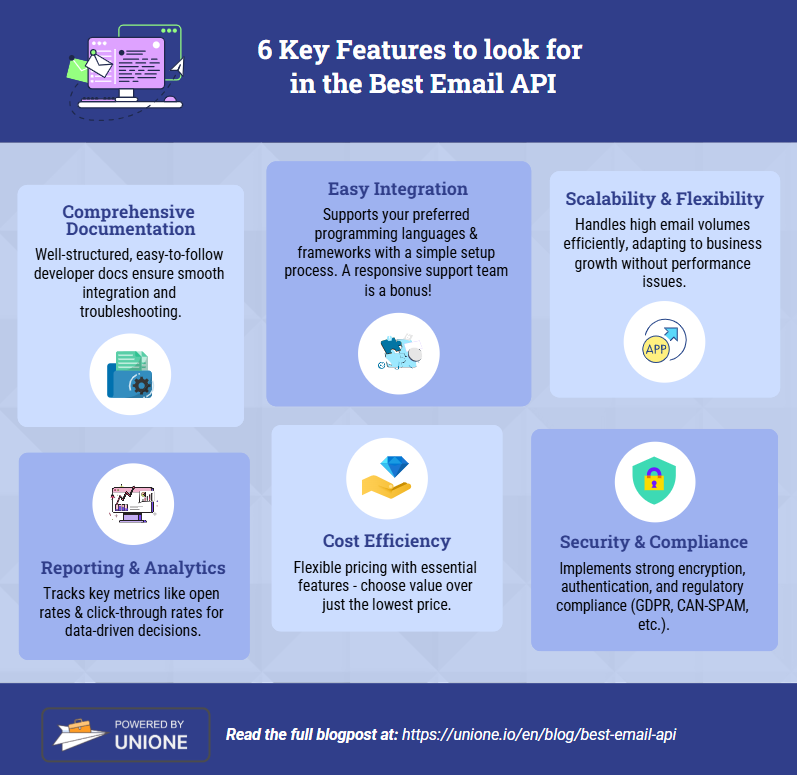
There are numerous email API providers out there. As you look through your options, what features should you consider? Below are key factors that can help you select the right service.
Documentation quality
The best email API can be challenging if there are no resources on how to use it. That is why it’s essential to prioritize services with organized and comprehensive documentation.
Take a look at the developer docs before selecting an API. There should be clear guides with all the needed information for a successful integration.
Simple integration process
What does it take to implement the solution? The goal of using email APIs is to simplify your tasks, not complicate them. It’s important to ensure the API is easy to integrate. Also, check if it supports your preferred programming languages and frameworks.
Plus, does the company provide a support team? If you are having any technical difficulties, getting access to a knowledgeable team should be easy.
Scalability and flexibility
The API should be designed to handle growing demands as businesses expand. This flexibility is important because the tool adapts to increasing amounts of work. Ensure the API can accommodate large volumes of emails without sacrificing performance. You need an email API that is reliable even during peak hours.
Reporting and analytics
The email API you choose should allow access to performance metrics. You should be able to monitor open rates, click-through rates, and so on. These analytics are important for tracking the efficiency of your campaign. That way, you can refine your strategies and make informed decisions for business growth.
Cost efficiency
Most providers offer flexible pricing structures based on features and volume. You can choose a plan that suits your business size and budget. However, the cheapest email API shouldn’t eliminate essential features like email logs on basic plans. When comparing prices, ensure the tool offers the best value even as your email volume scales.
Security and regulatory adherence
The API should implement strong security measures and policies. It should provide data encryption at different levels, robust authentication, and other security protocols. In addition, look for providers that are compliant with regulations like GDPR and the CAN-SPAM Act.
5 Best Email APIs
Let’s look at the top email API providers, highlighting their features and pricing structures. Each platform has its strengths and caters to different use cases.
UniOne
UniOne is the best email API for sending marketing and transactional emails. It provides a reliable infrastructure that offers high deliverability with all types of mail.
Developers enjoy straightforward email API integration and a dedicated support team. Besides the robust and fast web API, it offers other options like an easy-to-integrate SMTP service.
For organizations dealing with high volumes, UniOne’s web API handles millions of emails per hour. The team works diligently to ensure every email gets to designated recipients. UniOne delivers billions of emails yearly and boasts a success rate of 99.88%.
You can choose from extensive rich templates for personalization. There is also an option to create custom templates with its visual builder.
Beyond its comprehensive API, UniOne also provides functionalities for tracking vital email activities. From sending and receiving to bounce rates and delivery statuses, every event is time-stamped.
Pros
High deliverability rates: UniOne boasts its service can deliver up to 60 million emails an hour, and 99.88% are successful.
Dedicated team: Developers and businesses enjoy peace of mind with this provider. Thanks to the dedicated team with over 15 years of experience. You can reach customer support 24/7 via live chat and email.
Real-time webhooks: UniOne allows you to get instant notifications on email events.
Extensive email analytics: Visualize the performance of your campaigns in different ways. Analytics include an intuitive dashboard, CSV data exports, and real-time tracking.
Security and compliance: UniOne implements strong security protocols to protect user data. They are also compliant with major regulations like US CAN-SPAM and GDPR.
Cost-effective: It offers competitive pricing with a free trial. Each new user gets a free trial for four months to test the services.
Cons
Need for more templates: Some customers highlight they need additional default templates for different email types and industries.
Limited onboarding resources: While UniOne provides a responsive team for support, some users believe video tutorials would be beneficial.
Pricing
Free Plan
UniOne offers a four-month free trial, making it the best free email API for developers on a budget. During this period, users get free access to 6000 emails per month.
Paid Plan
After the free trial, you can continue using the plan at $4 for 6000 emails monthly. Additional messages beyond the 6000 will cost $0.75 per 1000 emails.
Postmark
Postmark is transforming email for developers and businesses. The team focused on building an email API that fits effortlessly into almost any programming language. With Postmark, integration is fast and seamless. Once you are done setting up, you can count on it to deliver reliably. You don’t need to worry about losing your crucial emails.
While most platforms mix both promotional and transactional messages, Postmark separates them. It does not use the same sending environment for all types of email. By doing so, they protect the delivery of transactional emails.
Moreover, Postmark provides a sandbox mode that makes testing easy. Developers can try out the service without the risk of sending messages to real recipients.
Postmark also offers templates for developers who don’t want to spend hours testing emails. The pre-built templates are for common messages like password resets, invoices, and welcome emails.
Pros
Speedy delivery: Postmark’s core business revolves around delivering messages on time. It ensures all your emails arrive at the intended recipient quickly.
Excellent customer support: Going by the positive reviews from customers, Postmark upholds great support as a standard.
Clear documentation: This API provider makes the set-up process seamless for developers. You have access to detailed docs, guides, and helpful webinars.
Message streams: This feature optimizes the time-to-inbox of all application emails. It uses distinct infrastructure to send transactional and promotional messages.
Detailed 45-day history: Postmark stores your insight for 45 days by default. However, you can change the retention period from 0 to 365 days. The stored data provides insight into metrics like bounces, open rates, and more.
Cons
Limited features: Postmark focuses solely on email delivery. For instance, it doesn’t have features for email marketing automation out of the box. Instead, they integrate tools that offer these services.
High cost: It is on the pricier side compared to other providers on the list.
Pricing
Free Plan
Postmark offers a free developer tier. This trial does not expire and gives you 100 emails each month.
Paid Plan
Postmark uses a volume-based pricing structure. Here’s a quick look at the basic plan:
- Price for 10,000 emails: $15 per month
- Price for 300,000 emails: $245 per month
- Price for 1,500,000 emails: $775 per month
SendGrid
SendGrid is one of the reputable email API providers in the industry. Trusted by leading businesses and developers to send billions of emails per month, it promises 99.99% uptime.
When SendGrid first started, the focus was only on transactional emails. However, after its acquisition by Twilio, it became an all-in-one solution for diverse email needs. It offers extensive features that include customer management and email marketing tools.
Developers employ SendGrid’s email API to integrate powerful functionalities in minutes. Setting up is seamless with helpful documentation and language-specific libraries.
When implementing, you can decide to leverage the SDK or use the API directly. SendGrid also gives you access to event webhooks, dynamic templates, and ISP monitoring.
Pros
One platform solution: It provides a range of features for deliverability, automation, marketing, and management. This makes it a one-stop provider for multiple email needs.
Solid documentation: SendGrid has comprehensive API docs, product guides, and resources. Developers can access the needed information for a successful and quick integration.
Scalability: This email API is designed to handle large volumes of emails. You can trust its advanced infrastructure to deliver reliably as demand grows.
Expert assistance: SendGrid provides a team of experts that integrate sophisticated tools, migrate, and troubleshoot issues.
Advanced reporting tools: You can access detailed insights on clicks, bounces, opens, and more through its user-friendly dashboard.
Cons
Pricing: The cost of utilizing the API can get significantly higher as your email volume increases.
Poor customer service: Users complain the quality of customer support has declined over time.
Pricing
Free Plan
SendGrid users can send 100 emails per day for free.
Paid Plan
SendGrid offers the following paid plans:
- Essentials plan: Send 50,000 – 100,000 emails starting at $19.95 per month
- Pro plan: Send 100,000 – 2,500,000 emails starting at $89.95 per month
- Premier: Custom pricing
Mailgun
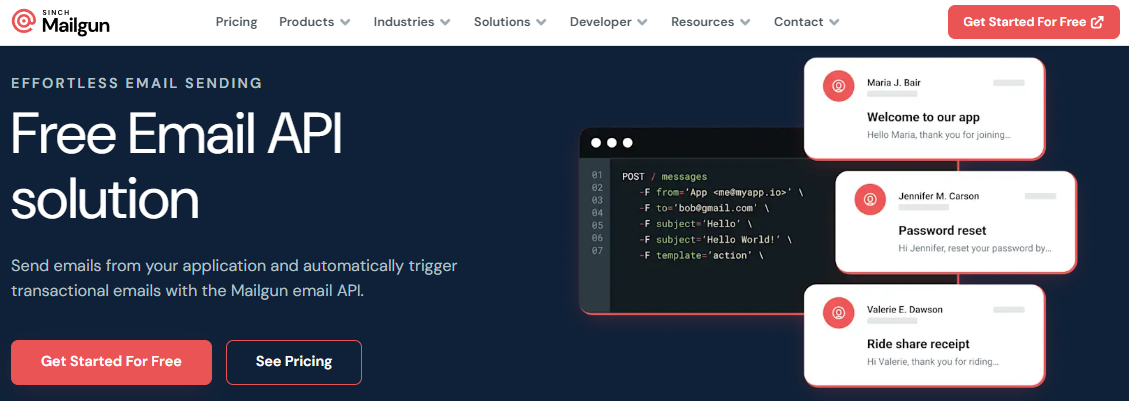
Mailgun is a developer-first email API for sending and tracking messages effortlessly. Founded in 2010, their goal was to make integrating email capabilities as effortless as possible. The team has remained committed to offering high deliverability to its users ever since.
This API provider stands out for its reliability. To prevent deliverability problems, Mailgun built an email verification system into its service.
This validation feature simplifies management tasks by ensuring your contact data is clean. It protects you from bad email addresses that affect delivery rates. Mailgun claims its customers notice their bounce rates improve by 21% on average.
Pros
Robust infrastructure: Mailgun provides a powerful API that optimizes email delivery and reliability.
Advanced features: Users can track the impact of campaigns with A/B testing features. It also offers email verification services, custom templates, and real-time tracking.
Inbound routing: Mailgun handles the parsing of your incoming messages. It extracts important data while removing irrelevant elements, such as repeated content from email threads.
Send Time Optimization: This feature holds your emails and waits until the recipient opens their inbox before sending.
Cons
Slow response time: Some users report unresponsive customer support. Handling some issues may take more time than required due to this.
Pricey services: For users who send higher email volumes, the cost of using Mailgun can be expensive.
Pricing
Free Plan
The free plan gives you access to 100 emails per day.
Paid Plan
Mailgun offers three paid plans. Each has unique features, so choose one that aligns with your needs.
- Price for 10,000 emails: $15 per month (Basic)
- Price for 100,000 emails: $75 per month (Foundation)
- Price for 500,000 emails: $400 per month (Scale)
Amazon SES
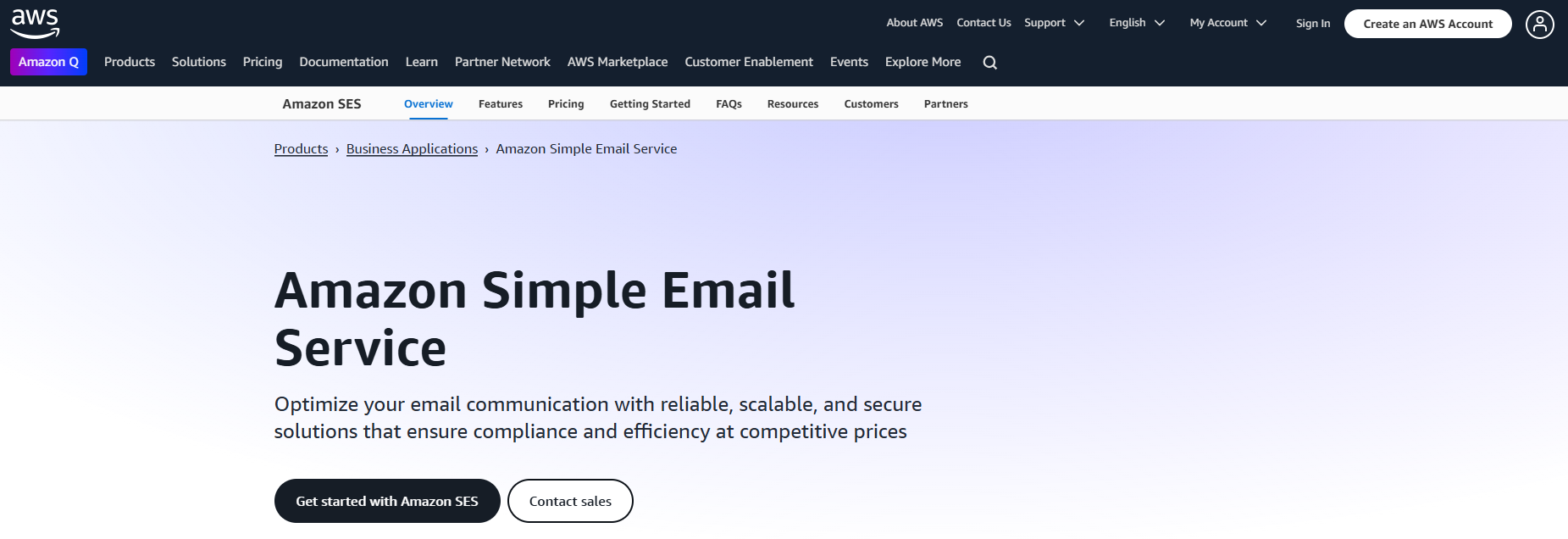
Amazon Simple Email Service (SES) is an excellent choice if you want the cheapest email API platform. It allows users to leverage the scalable Amazon infrastructure built to serve a large customer base. With Amazon SES, you can send all types of emails, including marketing and transactional.
Pros
Flexible pricing: Using Amazon SES is cost-effective. It uses a pay-as-you-go model, so there are no tiers or plans.
High deliverability: Amazon SES utilizes the reliable Amazon infrastructure, ensuring messages reach the recipients.
Email insights: Although the analytics are not as detailed as other providers, Amazon SES helps you track email performance.
Security and compliance: Amazon SES integrates with AWS Identity and Access Management (IAM). It’s also compliant with major regulations, including SOC, HIPAA, PCI, and others.
Cons
Complex set-up: Developers who are not familiar with AWS may find it difficult to integrate Amazon SES.
Steep learning curve: You will need technical expertise to efficiently utilize specific features and configurations.
Pricing
Free Plan
Amazon SES is a part of the AWS free tier for new users. Customers have access to 3000 free messages each month for the first year.
Paid Plan
There are no subscriptions with Amazon SES. You only pay for what you use. Amazon also charges separately for sending and receiving messages:
- Outbound emails: $0.10 per 1000 emails
- Inbound emails: $0.10 per 1000 emails
Best Practices for Email API Integration
Integrating an API into your application requires thoughtful planning. To help you navigate this process, below are tips for seamless integration.
Preparation and Planning for Integration
- Before you choose an API provider, it’s best to decide what goals you want to achieve. Clearly outline what you need, such as automating transactional emails, improving user engagement through campaigns, and so on.
- What email functionalities does your product require? Evaluate different providers to find one that offers the features you need.
- Additionally, email API providers offer documentation. Get familiar with your chosen API’s authentication methods, endpoints, and code samples.
Achieving Smooth Compatibility with Existing Systems
Smooth integration starts with following the provider’s instructions to obtain API keys or access tokens. These serve as authentication credentials for connecting to the email service.
Consider setting up a testing environment to verify integration works as expected. Test various activities, including sending emails to different addresses. To ensure reliability, strong error-handling mechanisms are crucial. Also, enable logging API interactions to facilitate troubleshooting.
Tracking and Enhancing API Performance
Continuous monitoring is important for meeting performance expectations. Email API providers often include analytics dashboards and reporting tools to access data in real-time.
Keep an eye on key metrics such as click rates, open rates, and bounces to evaluate the success of your email campaigns. Leverage these insights to refine your strategy and achieve better outcomes.
Conclusion
Selecting the best email API can be tough. It requires considering critical factors like security, cost, quality documentation, and scalability. Fortunately, there are numerous options to suit diverse needs.
The ideal API should align with your objective, whether it’s prioritizing cost-effectiveness or high deliverability. As you integrate, adhering to best practices will ensure smooth compatibility with your systems.
Each provider mentioned in this review offers incredible benefits in terms of performance. They also provide free plans and trials to help you explore their services before making a financial commitment.