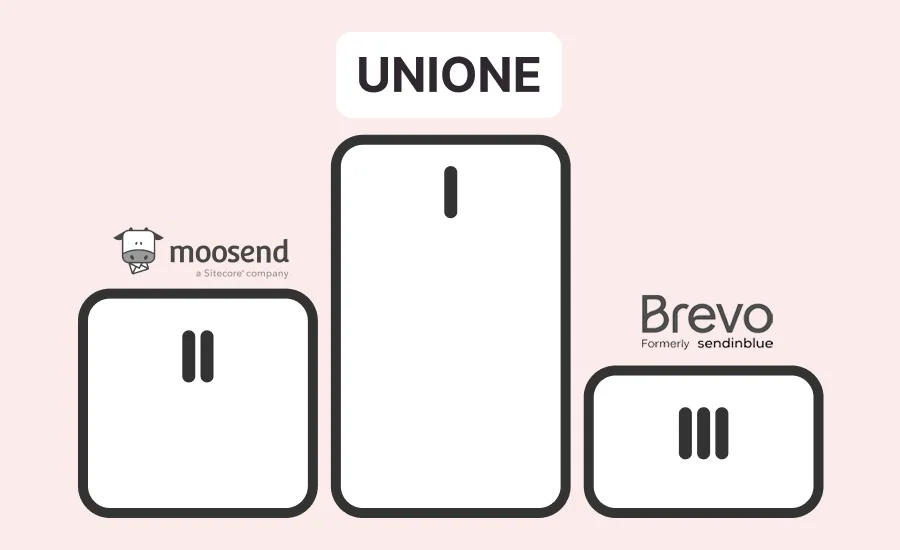

 30 april 2026, 11:54
Updated: October, 2026
MailerLite is still one of the easiest newsletter tools to start with, but its June 2026 repricing changed the math for a lot of teams. The free plan now stops at 250 subscribers, paid plans are priced by subscriber tier, and transactional email lives in a separate product (MailerSend) with its own bill. If you send order confirmations, password resets, or high-volume campaigns from the same stack, those three facts can push your costs up quickly.
This guide compares 14 MailerLite alternatives on the details that actually change your invoice: how each vendor bills (per email, per contact, or per active profile), what the free option really includes, and which features sit behind higher tiers. Every price below links to the vendor’s own pricing page and was checked in October 2026. Pricing in this category changes often, so treat the numbers as a starting point and confirm the live slider before you commit.
Top Alternatives To MailerLite
The “Pricing basis” column matters more than the headline price. A tool billed per email can be far cheaper than a tool billed per contact if you have a large list and send infrequently, and the reverse is true for small, highly engaged lists.
| Platform | Free option | Pricing basis | Starting paid price | Best for |
|---|---|---|---|---|
| UniOne | 4-month free trial | Emails sent | $6/month50,000 emails | Developers, SaaS, and ecommerce teams sending transactional and bulk email |
| Sender | Free Forever plan | Subscribers | $9/monthbilled annually, 500 subscribers, 6,000 emails | Small businesses and ecommerce stores on a budget |
| Brevo | Free plan | Emails sent | $9/month5,000 emails | SMBs that want email, SMS, and WhatsApp in one place |
| GetResponse | 14-day trial, then a limited free version | Contacts | $19/month1,000 contacts | Creators and marketers who want webinars and funnels |
| SendPulse | Free plan | Subscribers | $9.60/monthbilled annually, 500 subscribers | Marketers who need email plus chatbots |
| Omnisend | Free plan | Contacts | $16/month500 contacts, 6,000 emails | Shopify and WooCommerce stores |
| ActiveCampaign | 14-day trial | Contacts | $15/monthbilled annually, 1,000 contacts | Teams that need advanced automation and CRM |
| Mailchimp Transactional | 500 free test sends | Emails sent25,000-email blocks | $20 per blockplus a Mailchimp Standard or Premium plan | Teams already on Mailchimp |
| Mailjet | Free plan | Emails sent | $9/month8,000 emails | Marketing teams that collaborate on email design |
| Kitformerly ConvertKit | Free plan | Subscribers | $33/monthbilled annually, 1,000 subscribers | Bloggers, creators, and paid newsletters |
| Constant Contact | Free trial | Contacts | $12/month | Small businesses running events |
| Klaviyo | Free plan | Active profiles | $20/month500 profiles, 5,000 emails | Mid-size to large ecommerce brands |
| AWeber | Free plan | Subscribers | $15/monthor $12.49/month billed annually, 500 subscribers | Entrepreneurs and solo creators |
| SendGrid | 60-day trial | Emails sent | $19.95/monthEmail API Essentials | High-volume developer sending |
What is MailerLite?
MailerLite is an email marketing platform for creators, small businesses, and agencies. It covers newsletters, a drag-and-drop editor, automations, landing pages, websites, signup forms, and digital product sales. Since June 2026 it sells four plans: Free, Comfort (from $12/month), Power (from $25/month), and a custom Enterprise plan for lists above 200,000 subscribers, according to MailerLite’s pricing page. Transactional emails are not part of these plans; MailerLite points users to its sister product, MailerSend, for that.
Why Are People Switching From MailerLite?
Reason #1: Pricing Rose In June 2026
MailerLite renamed its Growing Business and Advanced plans to Comfort and Power on June 16, 2026, and third-party pricing trackers reported increases of roughly 10% to 30% depending on list size. The free plan also shrank: it now covers 250 subscribers and 2,500 emails a month, down from the 1,000 subscribers and 12,000 emails many older reviews still quote. Because Comfort gives you a send allowance of 10 times your subscriber tier, frequent senders often have to move up to Power for unlimited sends, which widens the gap further as the list grows.
Reason #2: Transactional Email Is A Separate Product
MailerLite’s pricing page lists transactional email as “Try MailerSend” on every plan, including Enterprise. That means a SaaS or ecommerce business needs two accounts, two integrations, and two bills to cover both newsletters and order or account notifications. If that sounds familiar, our guide to MailerSend alternatives covers the transactional side in more depth.
Reason #3: Support And Deliverability Tools Are Tier-Gated
On MailerLite, the Free plan gets community support, Comfort gets 24/7 email support, and live chat is reserved for Power. A dedicated IP is available only as an Enterprise add-on for accounts with 200,000+ subscribers. Teams that want fast human support or control over their sending reputation at a smaller scale often look elsewhere.
1. UniOne – Best For Reliable Email API
UniOne is an email delivery platform that handles both transactional email and bulk email marketing on a single plan, which solves the MailerLite and MailerSend split in one move. You can send through a Web API or SMTP, and every plan includes the same feature set, so you are not paying extra to unlock webhooks or analytics.
Compared with MailerLite, the differences that matter most are structural. UniOne prices by emails sent rather than subscribers, so a large list you email once a month costs far less. Support is 24/7 by live chat and email on every plan, while MailerLite holds live chat back for Power. Event logs are kept for up to 45 days and analytics data for up to 100 days, which is unusually long next to Sender (1 day of logs on its Free and Standard plans) or SendGrid Essentials (3 days of searchable email activity). A dedicated IP is available as an add-on at any volume, instead of only at enterprise scale.
For building emails, UniOne includes 200+ ready-made templates, a drag-and-drop email builder, and an AI-powered HTML editor. Instant webhooks report delivery, open, click, and unsubscribe events in real time (if you are new to them, here is what a webhook is), and campaign tagging lets you group sends by type, topic, or sender. Agencies can also run client campaigns under their own brand with UniOne’s white label email service.
Pros
- Low cost at volume: the Standard plan starts at $6/month for 50,000 emails, and extra emails cost $0.30 to $0.75 per 1,000 depending on volume.
- One plan for transactional and marketing email: no second product or second contract.
- Long data retention: up to 45 days of logs and 100 days of analytics on the Standard plan.
- 24/7 human support: live chat and email support on every plan.
- Pre-designed templates: 200+ ready-made templates plus a drag-and-drop builder and AI-powered HTML editor.
- Flexible deliverability setup: shared IP pools by default, with a dedicated IP available as an add-on.
Cons
- No SMS or multichannel messaging: UniOne focuses on email delivery only.
- Not a full marketing suite: landing pages, signup forms, and a built-in CRM are not part of the plan, so teams that rely on MailerLite’s site builder will need another tool for those.
- Card required to activate the trial: the free plan is activated in the Billing section by adding a credit or debit card.
- Limited validations on smaller plans: plans up to 50,000 emails include 100 email address validations; 6,000 are included from the 100,000-email tier.
Pricing
Free Trial
- Duration: 4 months.
- Allowance: 6,000 emails per month plus 100 email address validations.
- After the trial, the same plan continues at $4/month for 6,000 emails. Extra messages cost $0.75 per 1,000.
Standard Plan
- From $6/month for 50,000 emails.
- Includes transactional and bulk sending, Web API and SMTP, 200+ templates, an AI-powered HTML editor, instant webhooks, up to 45 days of log retention, up to 100 days of analytics storage, and 24/7 live chat and email support.
- Extra emails cost from $0.75 per 1,000 (up to 100,000 emails) down to $0.30 per 1,000 (3 million emails).
Individual Plan
- Custom pricing for high-volume senders, with a dedicated account manager, comprehensive onboarding, and prioritized 24/7/365 support.
Add-ons: dedicated IP at $40/month plus a $20 one-time setup fee per IP; extended support from $300/month.
Pricing verified on UniOne’s pricing page in October 2026.
2. Sender – Best For Affordable Email Marketing With Transactional Email
Sender is one of the closest like-for-like replacements for MailerLite. It combines newsletters, automation, segmentation, popups, landing pages, and transactional email (via SMTP and API) in one platform, and its free plan is far more generous than MailerLite’s current one.
The Free Forever plan covers up to 2,500 subscribers and 15,000 emails per month, with automation, landing pages, signup forms, and transactional emails included. Paid plans remove Sender branding and add SMS, A/B testing, and ecommerce reporting, and 24/7 email and live chat support is available on every plan, including the free one.
Pros
- Generous free plan: 2,500 subscribers and 15,000 emails per month.
- Transactional email included: SMTP and API sending on all plans.
- 24/7 support on every plan: email and live chat, even on Free.
- Pay-as-you-go option: credits from 29for5,000emails(5.80 per 1,000) for occasional senders.
Cons
- Sender branding on the free plan: removed only on paid plans.
- Very short log retention: 1 day on Free and Standard, 5 days on Professional.
- Advanced features are tier-gated: advanced automation, advanced reports, and dedicated IPs (on 20,000+ subscriber plans) require Professional.
Pricing
Free Plan
- Up to 2,500 subscribers and 15,000 emails per month, with Sender branding.
Paid Plans (500 subscribers, annual billing)
- Standard: 108/year(9/month) for up to 6,000 emails/month. First-time users currently get 30% off the first year ($75.60).
- Professional: 180/year(15/month) for up to 12,000 emails/month. First-year price with the discount is $126.
- Enterprise: custom pricing, unlimited emails, phone support, and a dedicated success manager.
Send limits scale with list size (12x subscribers on Standard, 24x on Professional).
Pricing verified on Sender’s pricing page in October 2026.
3. Brevo – Best For Multi-Channel Marketing And Phone Support
Brevo (formerly Sendinblue) bundles email, SMS, WhatsApp, live chat, a sales CRM, and transactional messaging in one platform. Like UniOne, it prices by emails sent rather than contacts, which makes it attractive for businesses with large but infrequently mailed lists. Transactional email via API and SMTP is available on every plan, including Free.
Audience segmentation, a drag-and-drop editor, and AI content tools are included from the Starter plan. Marketing automation, A/B testing, and landing pages begin on Standard, and phone support and multi-user access arrive on Professional.
Pros
- Free to start: 300 emails per day with transactional email included.
- Volume-based pricing: you pay for sends, not stored contacts.
- Broad channel coverage: SMS, WhatsApp, push, and live chat alongside email.
Cons
- Daily cap on the free plan: 300 emails per day.
- Branding on Starter: removing the Brevo logo on Starter is a paid add-on; it is included from Standard.
- Big jump to Professional: phone support and 10-seat access start at $499/month.
Pricing
Free Plan
- 300 emails per day.
Paid Plans (monthly billing; yearly billing saves 10%)
- Starter: from $9/month for 5,000 emails.
- Standard: from $18/month for 5,000 emails, adding marketing automation, A/B testing, one landing page, and no Brevo logo.
- Professional: from $499/month for 150,000 emails, adding WhatsApp, multi-user access, contact scoring, and phone support.
- Enterprise: custom pricing.
Plan features verified on Brevo’s pricing page; entry prices cross-checked with Moosend’s Brevo pricing analysis in October 2026.
Check out the top Brevo alternatives as well.
4. GetResponse – Best For Comprehensive Marketing Suite With Webinars
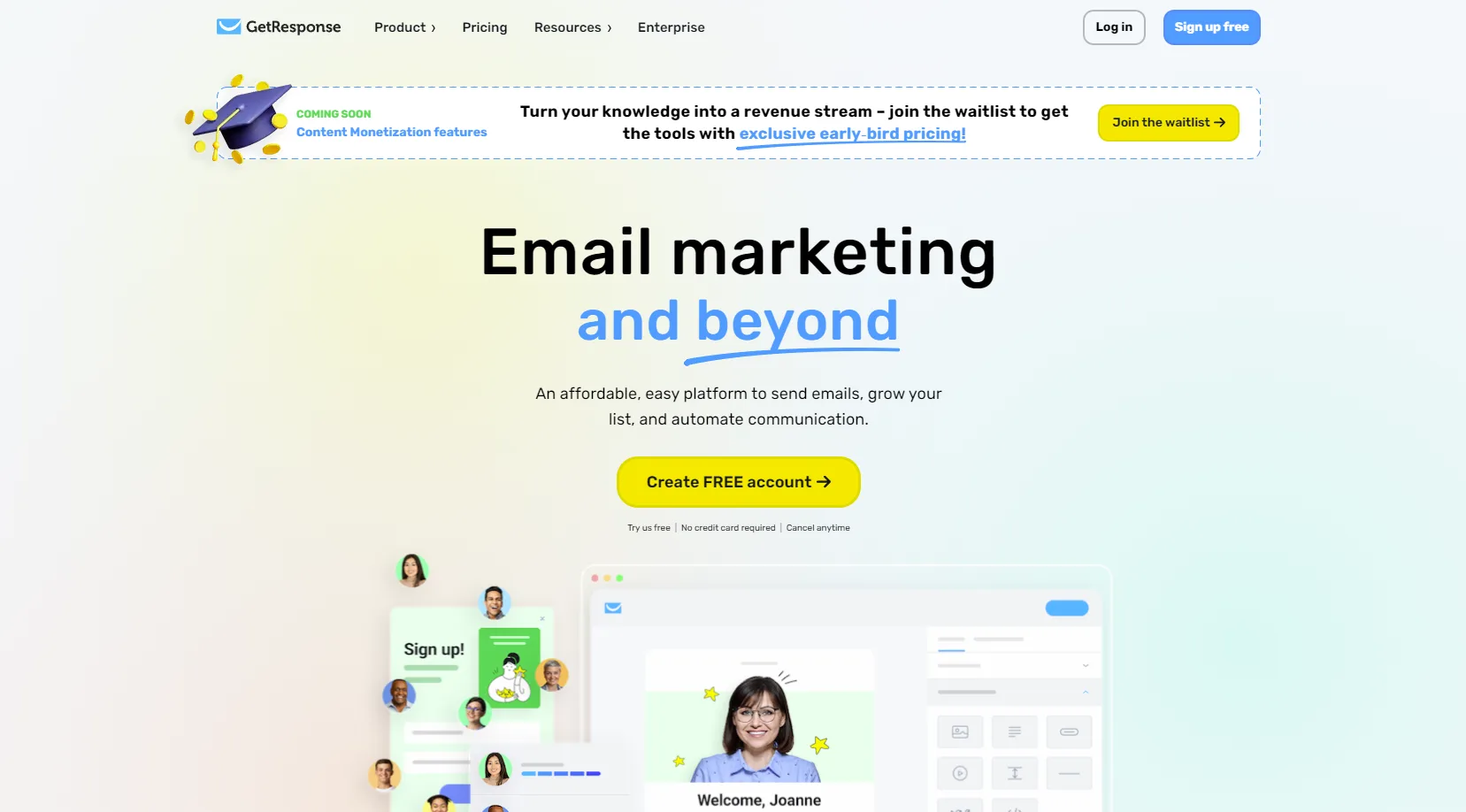
GetResponse is an all-in-one marketing platform covering email, landing pages, signup forms, popups, web push notifications, conversion funnels, and, on higher tiers, webinars and online courses. Every paid plan includes unlimited monthly email sends, so pricing depends only on the number of contacts you store.
Its standout feature is the conversion funnel builder, which ties ads, landing pages, signup forms, and abandoned cart emails into a single flow with stage-by-stage reporting. Webinar hosting, a website builder, and a course creator are included on the Creator plan.
Pros
- Unlimited sends on every paid plan: helpful for frequent senders.
- Built-in webinars and courses: included on Creator, no extra tool required.
- Generative AI tools: AI email, subject line, and landing page generators (limited uses on Starter).
Cons
- Automation is thin on Starter: only one custom automation workflow; unlimited workflows, contact scoring, and abandoned cart recovery start on Marketer.
- No A/B testing on Starter.
- Phone support is Enterprise-only.
Pricing
Free Option
- New accounts start with a 14-day trial. Afterward, a limited free version stays available, capped at 500 contacts and about 2,500 emails per month, according to independent testing.
Paid Plans (1,000 contacts)
- Starter: $19/month, or $15.58/month billed annually.
- Marketer: $59/month, or $48.38/month billed annually.
- Creator: $69/month, or $56.58/month billed annually.
- Enterprise: custom pricing, with SSO, a dedicated IP, transactional emails, and phone support.
Pricing verified on GetResponse’s pricing page in October 2026.
5. SendPulse – Best For Multi-Channel Marketing
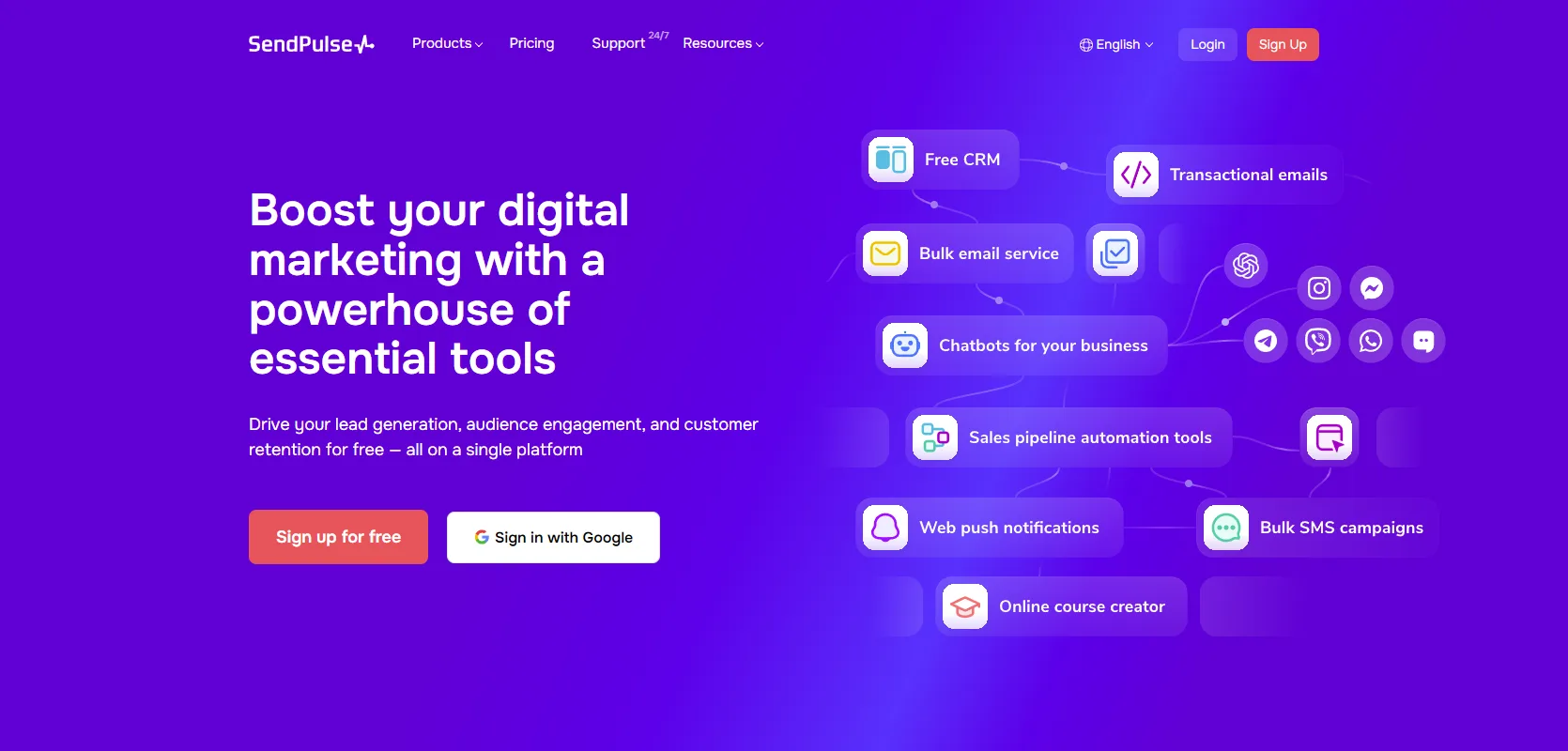
SendPulse is a marketing automation platform that combines email with SMS, web push, Viber, and chatbots for WhatsApp, Instagram, Telegram, Facebook, and TikTok. It also offers a CRM, a website and landing page builder, and a course builder, each priced as a separate product.
For email, SendPulse offers both subscription plans and pay-as-you-go credits, and every plan (including Free) comes with 24/7 live chat and email support.
Pros
- Generous free email plan: 15,000 emails per month for up to 500 subscribers.
- Pay-as-you-go option: useful for irregular senders.
- Wide channel mix: chatbots and messengers alongside email.
Cons
- Modular pricing adds up: chatbots, SMS, transactional email (SMTP), and websites are each priced separately.
- Automation and segmentation scale by tier: Standard allows 10 automated flows and 10 saved segments; Pro raises that to 50.
- Enterprise requires at least 2,500 contacts.
Pricing
Free Plan
- 15,000 emails per month for up to 500 subscribers.
Paid Plans (500 subscribers, annual billing)
- Standard: $9.60/month, unlimited emails, A/B testing, and no SendPulse branding.
- Pro: $11.52/month, adding dynamic segmentation, re-engagement emails, and 10 users.
- Enterprise: $16.13/month (requires at least 2,500 contacts), adding unlimited users and dedicated support.
Pay-as-you-go email credits start at $48 for 10,000 emails on Standard.
Pricing verified on SendPulse’s pricing page in October 2026.
6. Omnisend – Best For E-commerce Automations
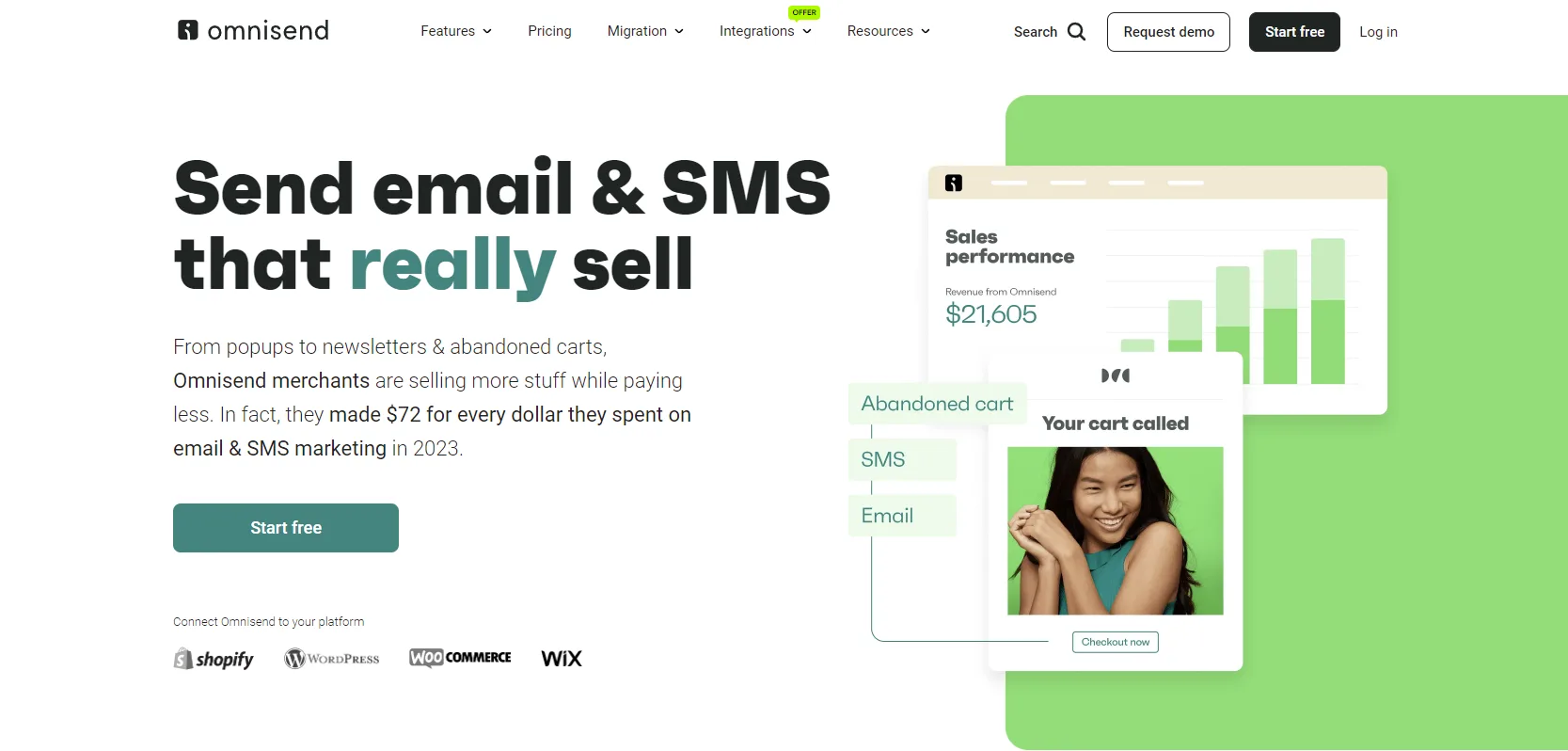
Omnisend is an email and SMS marketing platform built for online stores, with native integrations for Shopify, WooCommerce, BigCommerce, Wix, and more. It ships with pre-built ecommerce workflows for cart abandonment, welcome series, and post-purchase follow-ups, plus product recommendations, discount codes, and sales reporting.
The free plan is unusual: it includes the same features as paid plans, just with small volume limits. 24/7 live chat and email support is available on every plan, including Free.
Pros
- Free plan with full features: limited by volume, not by functionality.
- Built for ecommerce: pre-built workflows, product blocks, and revenue reporting.
- SMS bonus on Pro: Pro includes bonus SMS credits equal to your monthly bill.
Cons
- Send caps on Standard: Standard allows 12x your list size per month; unlimited sends require Pro.
- Branding on the free plan: the Omnisend badge is required on Free.
- Billing includes non-subscribers: contacts who receive automated messages count toward your bill even if they are not subscribed.
- Ecommerce-specific: less suited to SaaS or B2B use cases.
Pricing
Free Plan
- Up to 250 contacts and 500 emails per month.
Paid Plans (monthly billing)
- Standard: $16/month for 500 contacts and 6,000 emails per month.
- Pro: $59/month for 2,500 contacts and unlimited emails (subject to fair use).
New customers can currently pay three months upfront for 30% off.
Pricing verified on Omnisend’s pricing page in October 2026.
7. ActiveCampaign – Best For Pre-Built Automation Journeys
ActiveCampaign is a marketing automation platform with email, a CRM, landing pages, and 950+ pre-built automation recipes. It is a strong fit for teams that need branching, multi-trigger journeys and sales automation, but its depth comes with a steeper learning curve than MailerLite.
Send limits are tied to contacts (10x on Starter and Plus, 12x on Pro, 15x on Enterprise), and seats are limited on lower tiers: one user on Starter and Plus, three on Pro, and five on Enterprise.
Pros
- Deep automation: 950+ automation recipes and multi-trigger workflows.
- Built-in CRM: with Pipelines and Sales Engagement add-ons for sales teams.
- Wide integration ecosystem: 1,000+ apps, including major CRMs and ecommerce platforms.
Cons
- No free plan: only a 14-day trial.
- Starter is restrictive: 5 actions per automation, limited segmentation, and no landing pages.
- Gets expensive with list growth: prices climb steeply past the entry contact tier.
- Key extras are add-ons: SMS, WhatsApp, transactional email, and custom reporting cost extra.
Pricing
Free Plan
- No free plan; a 14-day free trial is available.
Paid Plans (1,000 contacts)
- Starter: $15/month billed annually, or $19 month-to-month.
- Plus: $49/month billed annually, or $59 month-to-month.
- Pro: $79/month billed annually, or $99 month-to-month.
- Enterprise: $145/month billed annually, or $179 month-to-month.
Plan features verified on ActiveCampaign’s pricing page; prices cross-checked with Automation Atlas in October 2026, since ActiveCampaign’s page loads prices dynamically.
Find out more ActiveCampaign alternatives.
8. Mailchimp Transactional (Formerly Mandrill): Best For Existing Mailchimp Users
Mailchimp Transactional is Mailchimp’s API for one-to-one messages such as receipts, password resets, and shipping updates. It is not sold on its own: you need a Mailchimp Standard or Premium marketing plan (Essentials is not eligible), and you then buy sending credits in blocks of 25,000 emails.
The upside is that marketers can edit templates in Mailchimp’s drag-and-drop builder while developers keep the API integration stable. It also supports transactional SMS from the same API, and a dedicated IP is available for $29.95/month.
Pros
- One account for marketing and transactional email: if you already use Mailchimp.
- Shared template editing: marketers and developers work from the same templates.
- Volume discounts: the price per block drops as you buy more.
Cons
- Two costs stacked together: block pricing plus a Standard or Premium Mailchimp subscription.
- Unused credits expire: emails in a block do not roll over month to month.
- Very limited free option: 500 test sends to a verified domain.
Pricing
Free Option
- New users can send up to 500 free emails to their verified domain.
Paid Plans (each block = 25,000 emails, on top of a Mailchimp Standard or Premium plan)
- 1 to 20 blocks (up to 500,000 emails): $20 per block.
- 21 to 40 blocks (500,000 to 1 million emails): $18 per block.
- 41 to 80 blocks (1 to 2 million emails): $16 per block.
- 161+ blocks (4 million+ emails): $10 per block.
Pricing verified on Mailchimp’s transactional email pricing page in October 2026.
Compare more Mailchimp Transactional alternatives.
9. Mailjet – Best For Collaborative Email Marketing
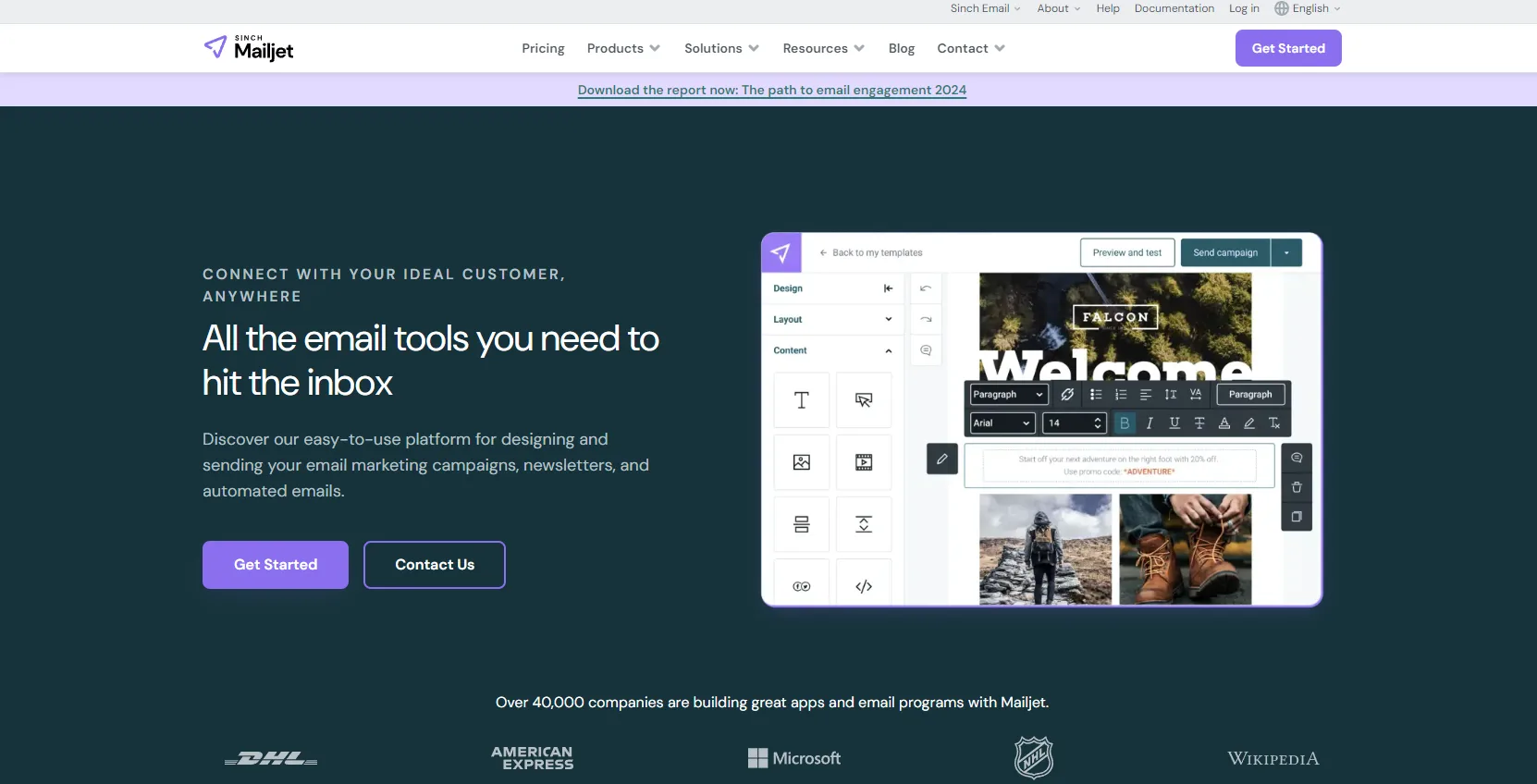
Mailjet (now Sinch Mailjet, a sister brand of Mailgun) covers both marketing email and transactional sending via API and SMTP relay. Its main differentiator is real-time collaboration: several team members can edit the same email, leave comments, and work from shared, locked sections on the Premium plan.
Pricing is based on emails sent. Contact limits apply on Free and Starter, while Essential and above include unlimited contacts.
Pros
- Transactional and marketing email in one account.
- Email-based pricing: unlimited contacts from the Essential plan.
- Team collaboration: multi-user editing and team management on Premium.
Cons
- Contact caps on lower tiers: 1,000 contacts on Free and 2,000 on Starter.
- Automations, landing pages, and A/B testing require Premium.
- Mailjet branding until Essential.
Pricing
Free Plan
- 6,000 emails per month (200 per day) and 1,000 contacts.
Paid Plans (monthly billing; annual billing saves 10%)
- Starter: $9/month for 8,000 emails, 2,000 contacts.
- Essential: $19/month for 15,000 emails, unlimited contacts, segmentation, and no Mailjet logo.
- Premium: $29/month for 15,000 emails, adding automations, landing pages, A/B testing, and team management.
- Custom: enterprise plans with a dedicated technical account manager.
Pricing verified on Mailjet’s pricing page in October 2026.
Looking for more Mailgun alternatives? Read our other article.
10. Kit (Formerly ConvertKit): Best For Creators And Newsletter Monetization
Kit, which rebranded from ConvertKit, is built for creators who want to grow and monetize an audience. Beyond newsletters, it lets you sell digital products and paid subscriptions, earn from newsletter sponsorships, and grow through the Kit Creator Network’s recommendations.
Kit’s free plan is one of the most generous in the category at up to 10,000 subscribers, though automations, sequences, and branding removal require a paid plan.
Pros
- Free plan for up to 10,000 subscribers: with unlimited landing pages, forms, and broadcasts.
- Monetization built in: digital products, paid newsletters, and sponsorships.
- Visual automations: unlimited automations and sequences on paid plans.
Cons
- No automations on Free: visual automations and email sequences start on Creator.
- Email-only support on Free: 24/7 chat support starts on Creator.
- Deeper analytics cost more: engagement analytics, deliverability reporting, and advanced A/B testing are Pro features.
Pricing
Free Plan
- Up to 10,000 subscribers.
Paid Plans (1,000 subscribers, annual billing)
- Creator: 33/month(390 billed yearly), with unlimited automations and sequences and 2 users.
- Pro: $66/month billed yearly, with unlimited users and advanced analytics. A limited-time offer currently brings the first year down to $50/month.
Paid plans come with a 14-day free trial.
Pricing verified on Kit’s pricing page in October 2026.
11. Constant Contact – Best For Cross-Channel Marketing
Constant Contact is a marketing platform for small businesses that combines email with social media posting, SMS (US only), event registration, and ecommerce tools. Every plan includes live phone and chat support and 300+ integrations.
Prices scale with contacts, and every plan carries a monthly send limit (10x your contacts on Lite, 12x on Standard, 24x on Premium). If you go over, sends still go out, but you pay $2 per 1,000 extra emails.
Pros
- Live phone and chat support on every plan.
- Event marketing tools: registration forms, payments, and ticket sales.
- 30-day money-back guarantee.
Cons
- No permanent free plan: only a free trial.
- Automation is limited on lower tiers: one automation template on Lite and three on Standard; custom automations require Premium.
- Overage fees: sends beyond your allowance are billed per email.
Pricing
Free Plan
- No free plan; a free trial is available with no credit card required.
Paid Plans (starting prices; price depends on contact count)
- Lite: from 12/month(10.20/month prepaid annually), 1 user.
- Standard: from 35/month(29.75/month prepaid annually), 3 users.
- Premium: from 80/month(68/month prepaid annually), unlimited users and 500 SMS per month.
Pricing verified on Constant Contact’s pricing page in October 2026.
See our full list of Constant Contact alternatives.
12. Klaviyo – Best For Automating Complex Workflows
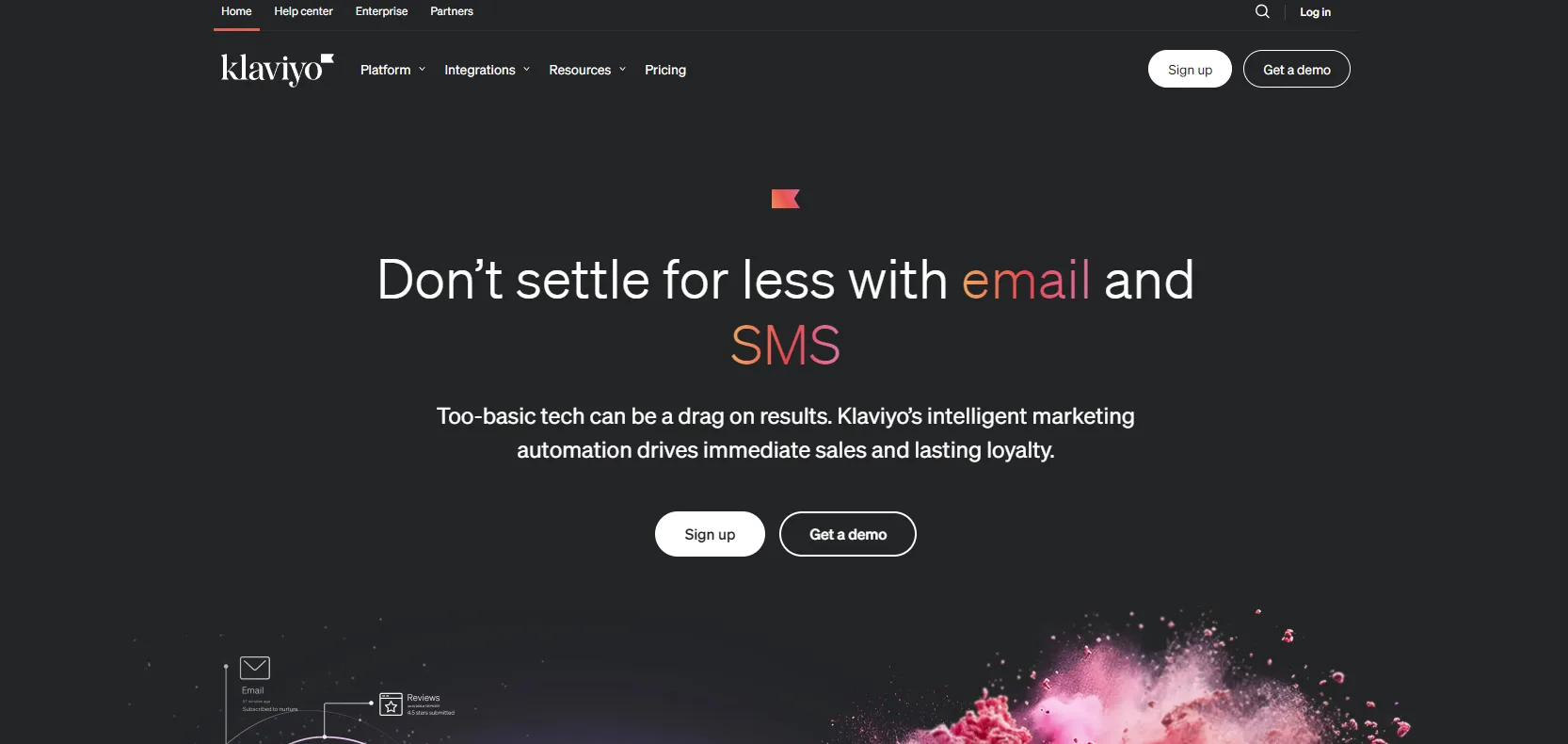
Klaviyo is a B2C CRM and marketing platform built around ecommerce data. It pulls in order, browsing, and product data from Shopify, Magento, WooCommerce, and others, then uses it for segmentation, predictive analytics, and personalized flows across email, SMS, and push.
Getting the most out of Klaviyo usually takes some technical setup or an agency, but retailers value the revenue attribution and reporting. Keep in mind that Klaviyo bills by active profiles, meaning every profile you can reach, not only the ones you email.
Pros
- Ecommerce-first data model: deep Shopify and Magento integrations.
- Powerful segmentation: with ad audience syncing for Facebook, Instagram, and Google.
- Pre-built flows: for abandoned carts, browse abandonment, and win-back.
Cons
- Active-profile billing: list hygiene directly affects your bill.
- Learning curve: beginners may need time or outside help.
- Limited free support: free plan email support lasts only the first 60 days, according to third-party reviews.
Pricing
Free Plan
- Up to 250 active profiles, 500 email sends, and 150 SMS credits per month.
Paid Plans (500 active profiles)
- Email: $20/month, including 5,000 email sends.
- Email and SMS: $35/month, adding 1,250 SMS credits.
Pricing checked on Klaviyo’s pricing page and cross-checked with Omnisend’s Klaviyo pricing breakdown in October 2026, since Klaviyo’s page loads prices dynamically.
13. Aweber – Best For Detailed Performance Reports
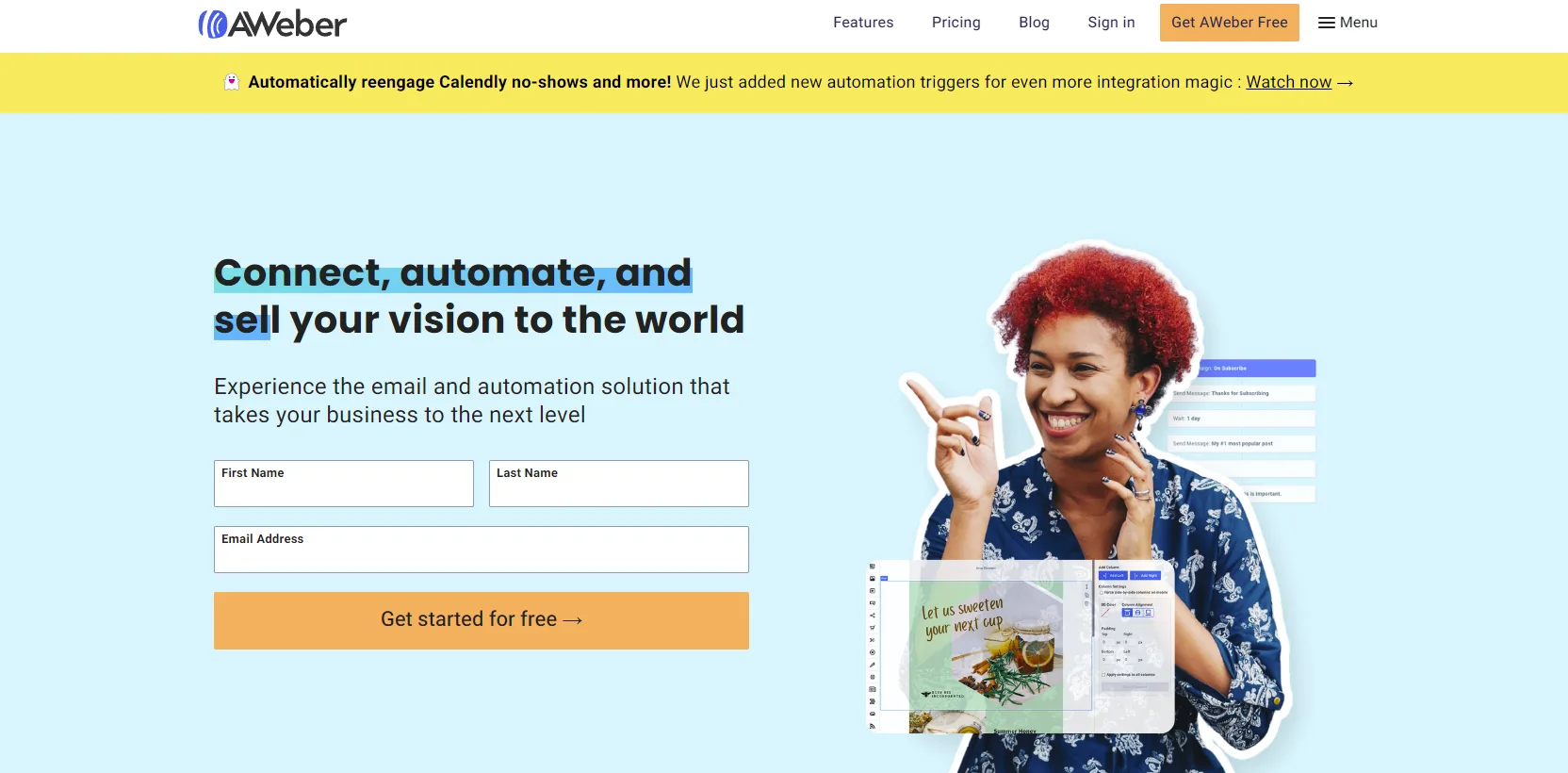
AWeber is a long-standing email marketing platform for entrepreneurs, coaches, and content creators. It includes landing pages, ecommerce tools for selling products and subscriptions, web push notifications, a Canva integration, and an AI writing assistant.
Its plans scale by subscriber count, and the Plus plan unlocks unlimited automations, landing pages, segments, and users, plus priority 24/7 support by chat, email, and phone.
Pros
- Free plan available: good for testing with a small list.
- Web push notifications: included alongside email.
- Unlimited users on Plus: helpful for small teams.
Cons
- Lite is limited: 1 email list, 3 automations, 3 landing pages, and 1 custom segment.
- Branding on Free: AWeber branding stays on free-plan emails.
- Split testing and behavioral automation require Plus.
Pricing
Free Plan
- Available, with AWeber branding. Independent reviews report limits of 500 subscribers and 3,000 emails per month (Hackceleration).
Paid Plans (500 subscribers)
- Lite: $15/month, or $12.49/month billed annually, with a send limit of 10x your subscriber count.
- Plus: $30/month, or $19.99/month billed annually, with a send limit of 12x your subscriber count.
Both paid plans include a 14-day free trial.
Pricing verified on AWeber’s pricing page in October 2026.
14. SendGrid – Best For SMTP And Related Marketing Features
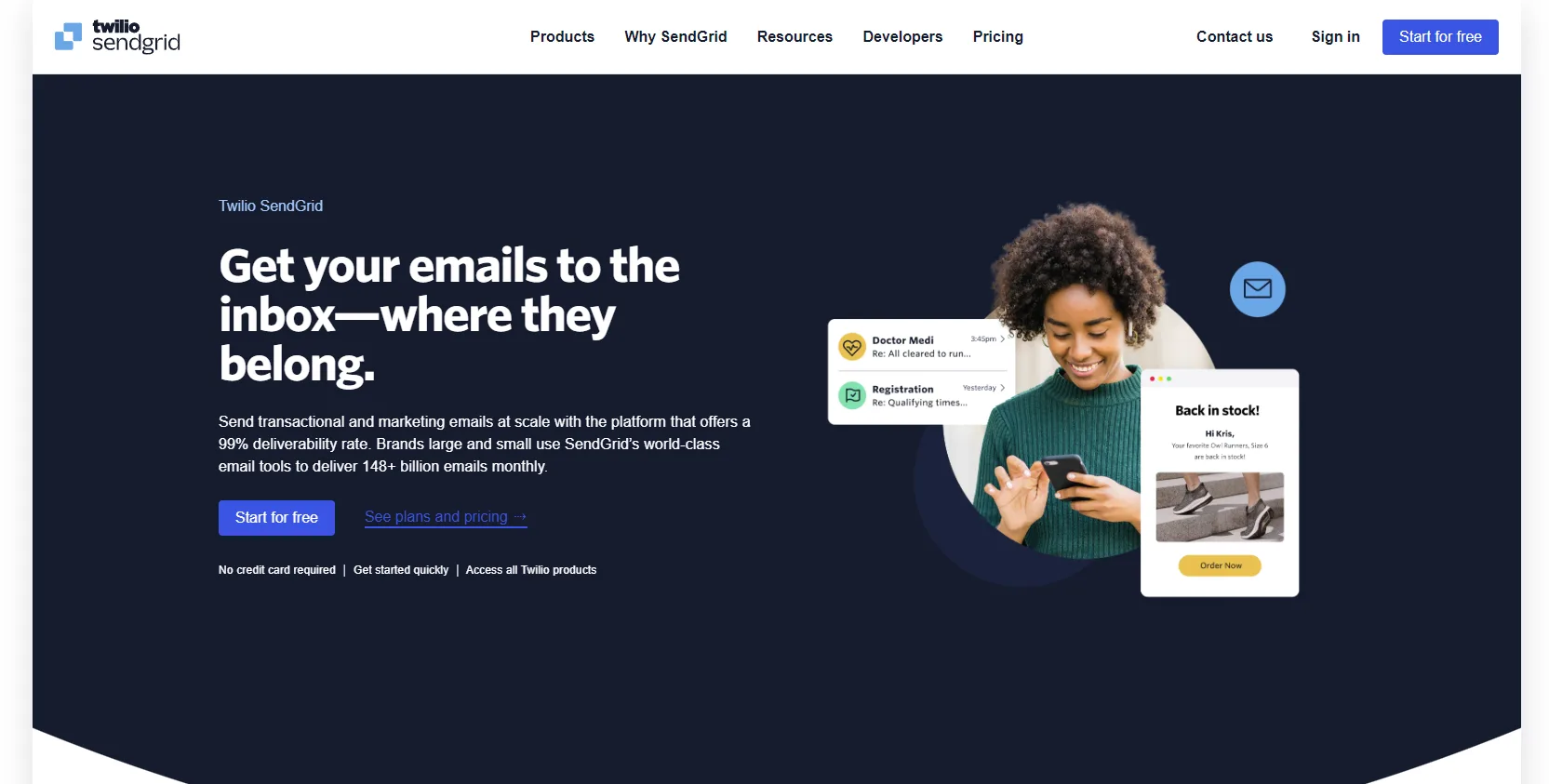
Twilio SendGrid is a cloud email platform known for its SMTP relay and REST API. It is a solid choice for developers sending large transactional volumes, but marketing and API sending are two separate products: if you want both, you buy and configure the Email API and Marketing Campaigns plans separately.
Dedicated IPs, subuser management, and SSO start on the Pro plan. Searchable email activity history is short by default (3 days on Essentials, 7 on Pro), with longer history available for purchase.
Pros
- Proven at scale: built for very high sending volumes.
- Strong developer tooling: client libraries, dynamic templates, and event webhooks.
- Dedicated IP included on Pro.
Cons
- No permanent free tier: the free option is a 60-day trial.
- Two products to manage: Email API and Marketing Campaigns are billed separately.
- Short activity history: 3 days on Essentials unless you pay for more.
- Complex setup for non-technical users.
Pricing
Free Trial
- 60 days, up to 100 emails per day.
Paid Plans (Email API)
- Essentials: from $19.95/month, aimed at senders of roughly 50,000 to 100,000 emails per month.
- Pro: from $89.95/month, including a dedicated IP, subuser management, SSO, and 2,500 email validations.
- Premier: custom pricing for very high volumes.
Marketing Campaigns are priced separately, with Basic from $15/month and Advanced from $60/month.
Pricing verified on SendGrid’s Email API pricing page and Marketing Campaigns pricing page in October 2026.
Find out more SendGrid alternatives, or see how UniOne compares with SendGrid.
How To Choose The Right MailerLite Alternative
Start with how you send, not with the headline price. If you mostly send newsletters to a list you are actively growing, a subscriber-based tool with a strong free plan (Sender, Kit, or Brevo) will feel the most familiar after MailerLite. If you run an online store, Omnisend and Klaviyo give you the ecommerce data and pre-built flows that MailerLite lacks.
If your product sends receipts, sign-up confirmations, or password resets, the bigger question is whether you want to keep marketing and transactional email in two separate tools. An email-based platform like UniOne lets you run both from one API and one invoice, which usually works out cheaper once your list grows past a few thousand contacts or your volume passes tens of thousands of emails a month. Whichever direction you choose, check three things before you switch: what the free plan really includes, how long you keep your sending logs, and whether support is available on your tier when something breaks.
Conclusion
Although MailerLite is an excellent email marketing platform, it may not be the best option for businesses looking to scale up, and you may want to consider alternatives. Here, we’ve reviewed the 14 best MailerLite competitors to help you find a solution with high deliverability, advanced automation, better customer support, and competitive pricing.
The choice, however, depends entirely on your needs, budget, and marketing objectives. Compare the options and decide on the one with the most promising features over the long haul.
FAQs
Is MailerLite Better Than Mailchimp?
It depends on what you need. MailerLite is generally simpler and cheaper at small list sizes, with Comfort starting at $12/month for 500 subscribers. Mailchimp offers a wider range of integrations and a transactional email add-on, but that add-on requires a Standard or Premium plan on top of block pricing. If you need both marketing and transactional email at a predictable price, an email-based platform such as UniOne is worth comparing.
Is MailerLite Free?
Yes. MailerLite’s Free plan supports up to 250 subscribers and 2,500 emails per month, with 2 user seats, 3 automations, one website, and one landing page. It also includes a 14-day trial of premium features. Free accounts get community support only, show the MailerLite logo, and cannot send email through the API or MCP server, so growing teams usually outgrow it quickly.